Entering the Rocky Mountains
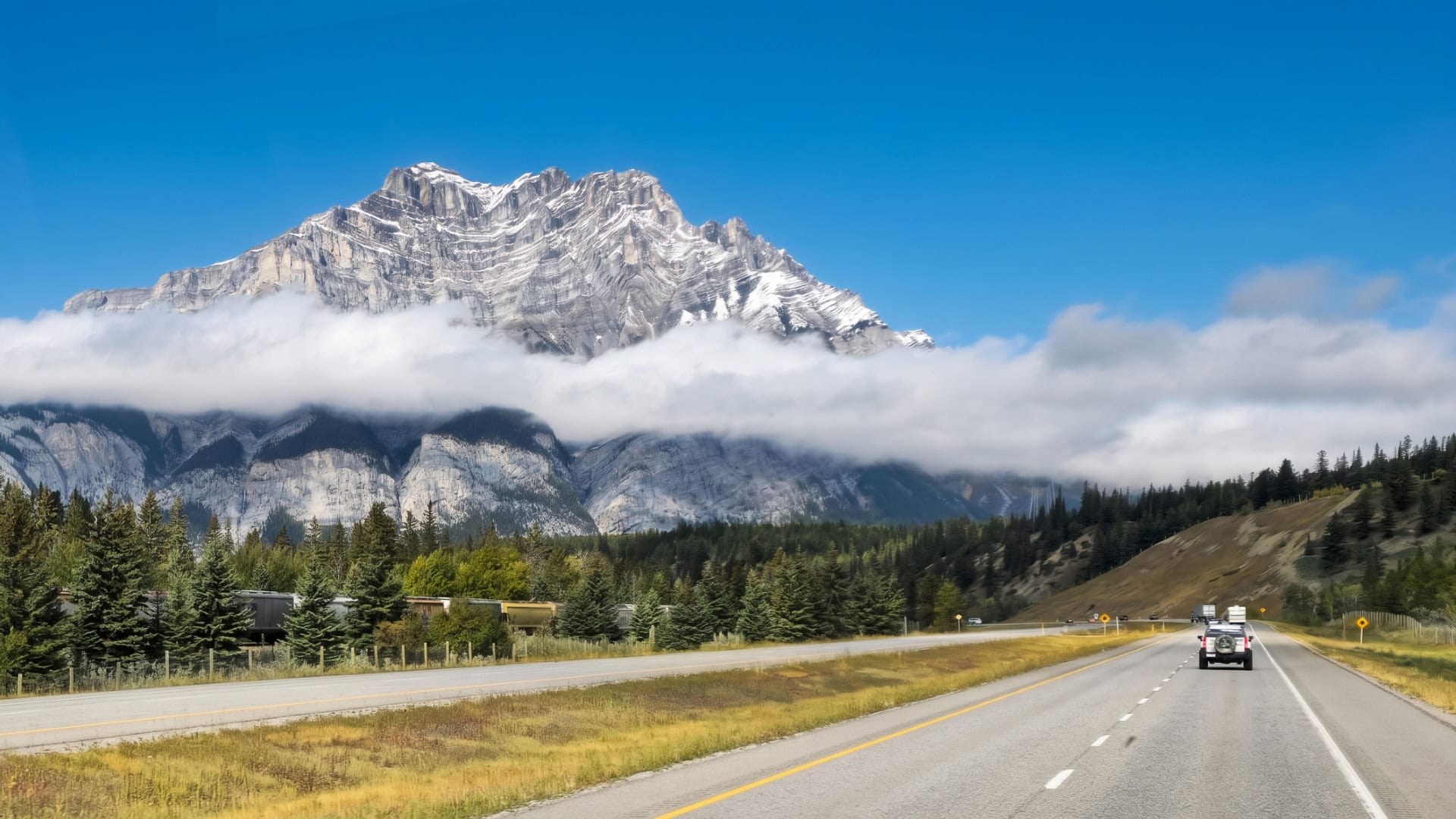
After a great two days visiting friends we hadn’t seen in years we left Cochrane and headed for the mountains. We arrived at our campground in Canmore, which had decommissioned its black- and grey-water dumping facilities in 2023. Fortunately, Jackie knew that before we made our booking. We emptied our tanks at a campground along our route to Canmore on Highway 1A. With empty black and grey water tanks, we knew we could easily stay in Canmore for a week without having to find a sani-dump site. Our campground site in Canmore provided great views of mountains in every direction but only when it wasn’t raining and the mountains weren’t hidden behind clouds.
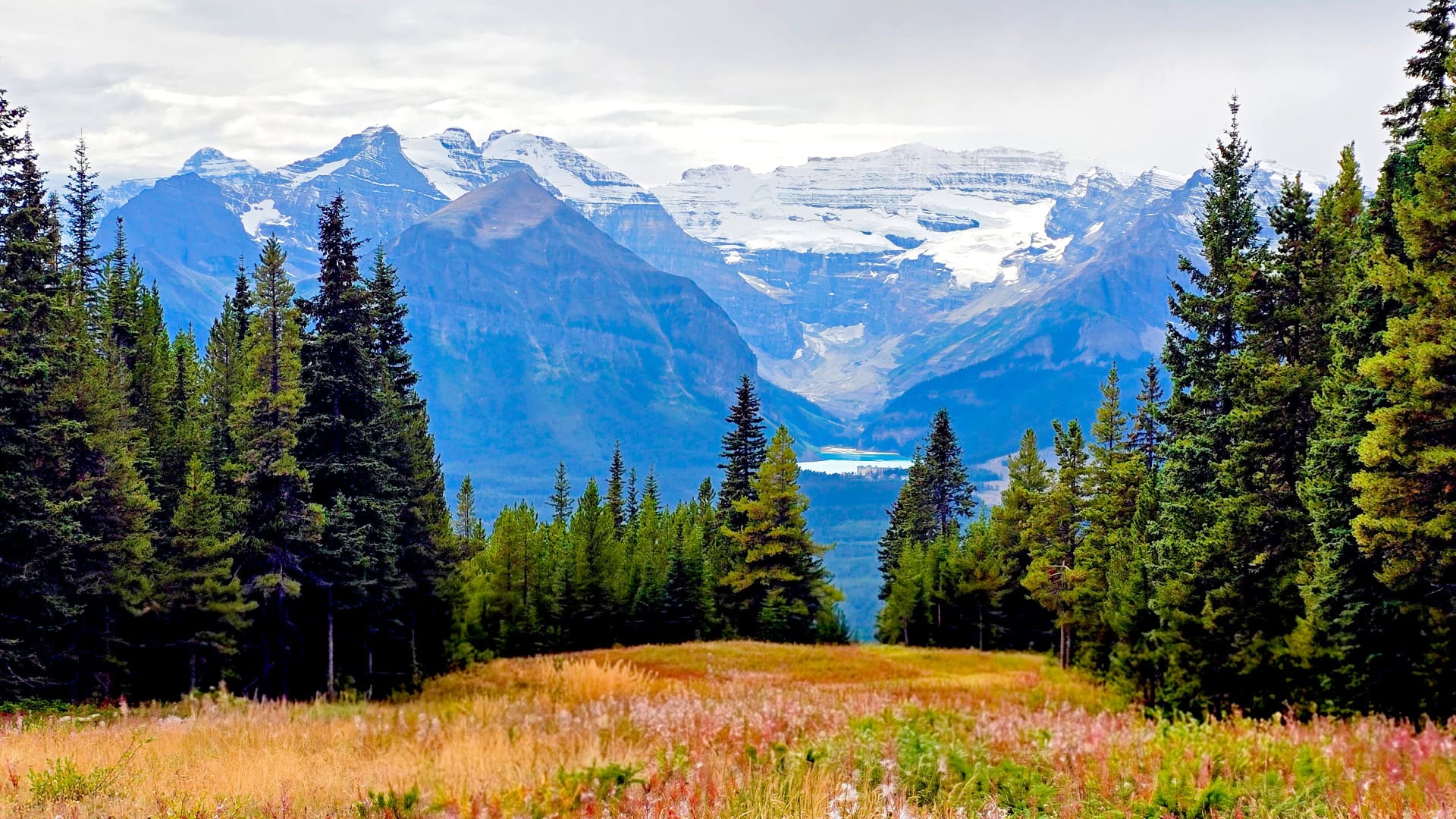
On the dry days, we visited Banff, Johnson Canyon and Lake Louise.
Banff has retained much of the charm that we remembered from previous visits more than a decade ago. Jackie wasn’t happy with how busy it had become. It has also become much more expensive. Fortunately, Canmore is a little less expensive, although it is still more expensive than most other places we have visited in Alberta. I guess that’s normal for a tourist destination. Apparently, mountains come with a premium price tag.
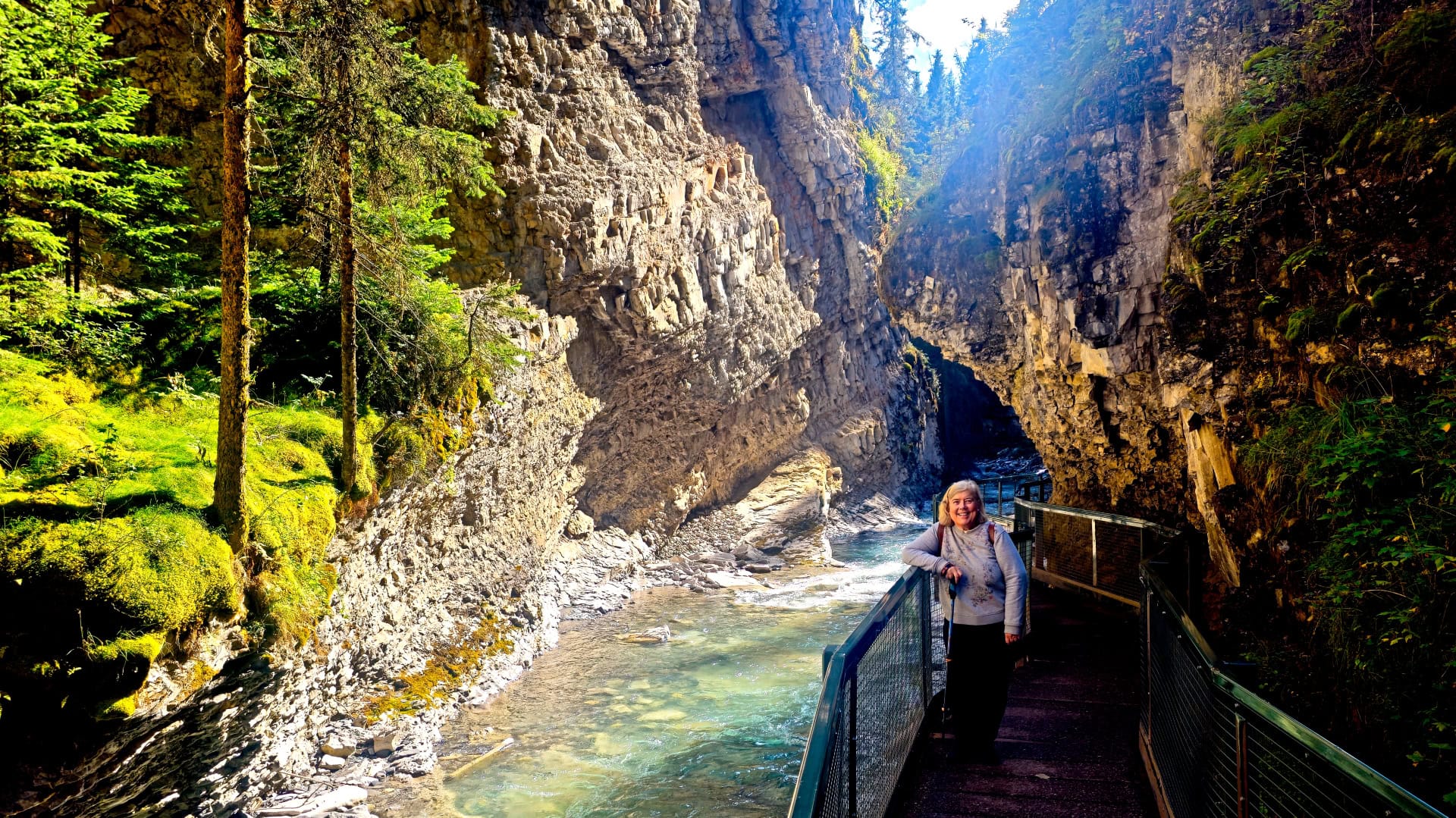
We rode our e-bikes from Johnson Canyon to Banff. Jackie developed an interesting plan for that ride so that we would only need to ride in one direction. She planned that we would drive past Banff to Johnson Canyon, where we would tie our e-bikes to a bike rack. We would then leave our bikes there and drive back to the train station in Banff. The train station offered free parking, so we would leave our car there and walk to the bus stop in the centre of town. At the bus stop, we would buy one-way tickets to Johnson Canyon. You can probably guess the rest of the plan.
We executed the plan more or less as described, with one adjustment. Before leaving Johnson Canyon on our e-bikes, we had lunch at the restaurant and hiked two kilometres round trip to the lower falls. Then we got on our bikes and headed toward Banff. This was one of those plans that sounds complicated when you explain it, but makes perfect sense once you’re actually doing it.
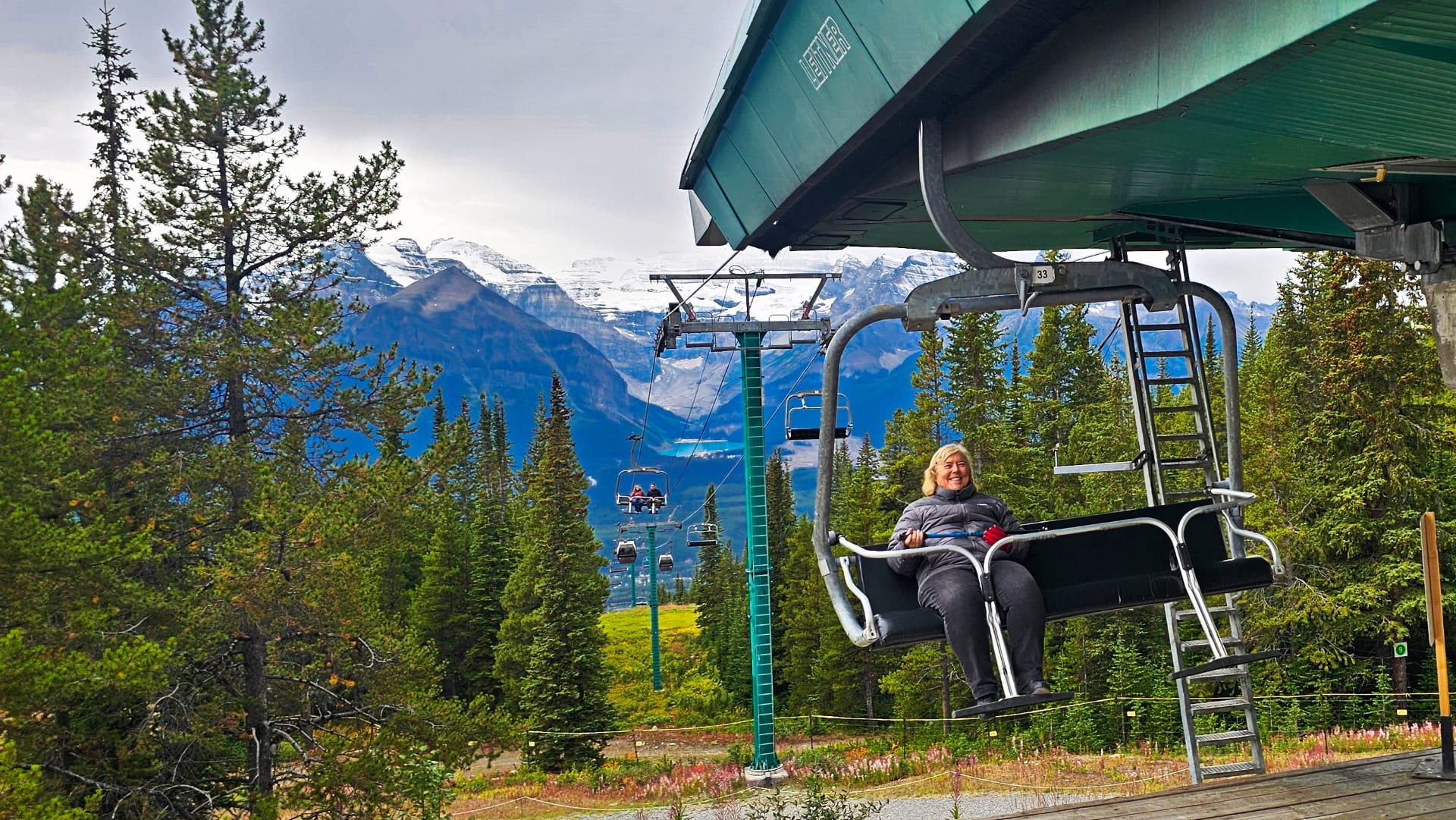
To tell the truth, our visit to Lake Louise was a bit of a bust. It was way too busy. We couldn’t find a parking space anywhere near the lake, so we went to the Lake Louise ski hill instead.
Jackie took a ski-lift chair up the hill while I took the gondola. The chairs and the gondolas both hang from the same cable, so they depart from and arrive at the same platforms. I like the gondolas better because they have a floor and walls, which provide me with a false sense of security. Jackie prefers the thrill of having her feet dangling over nothing.
Highway 1 east of Golden, British Columbia, snakes through Kicking Horse Pass. The pass has some very steep sections, with downhill grades of 6 to 8 percent extending for up to 15 kilometres. Some of the downhill sections are long enough that there are pullovers specifically signposted for heavy vehicles to inspect their brakes. I didn’t do that because our Tiffin is equipped with three levels of Jake (engine) braking. The Jake brake can only be used at speeds above 10 kilometres per hour and is activated by a lever on the steering column that toggles between off and the three levels of braking. Since I had not once pressed the brake pedal during the descent through Kicking Horse Pass into Golden, I didn’t bother stopping to inspect whether the disc brakes on the motorhome were overheating. That was a big mistake.
What I didn’t realize at the time was that when the Jake brake activates, the brake lights on the motorhome turn on. As it turns out, there is a setting in the Freightliner chassis software that allows this feature to be turned on or off by an authorized Freightliner service facility. In our motorhome, the feature was turned on.
Our towed car has been modified so that when the tail lights on the motorhome turn on, the Invisibrake system in the Escape activates the car’s brakes. So, as we descended through Kicking Horse Pass into Golden, the brakes on the Escape were being fully applied for extended periods. By the time we entered the campground in Golden, we had wrecked the car’s brakes as well as all four tires. Yikes! We needed new rotors, new calipers and new tires on all four corners. We limped the car to the Ford dealer in Golden. The repairs took five days, mostly because we were waiting for parts. The bill came to almost $5,200.
That was certainly one way to make our arrival in Golden memorable.
As we were leaving Golden, we stopped at the Freightliner service facility in town. They connected their computer to our motorhome and spent about an hour searching through seemingly endless lists of parameters in an unsuccessful attempt to find the setting that turns on the brake lights when the engine brake is activated. They couldn’t find it.
It looks like we will need to contact Freightliner for more information. In the meantime, I have adjusted the pressure on the Invisibrake controller so that the brakes won’t burn out on long mountain descents.
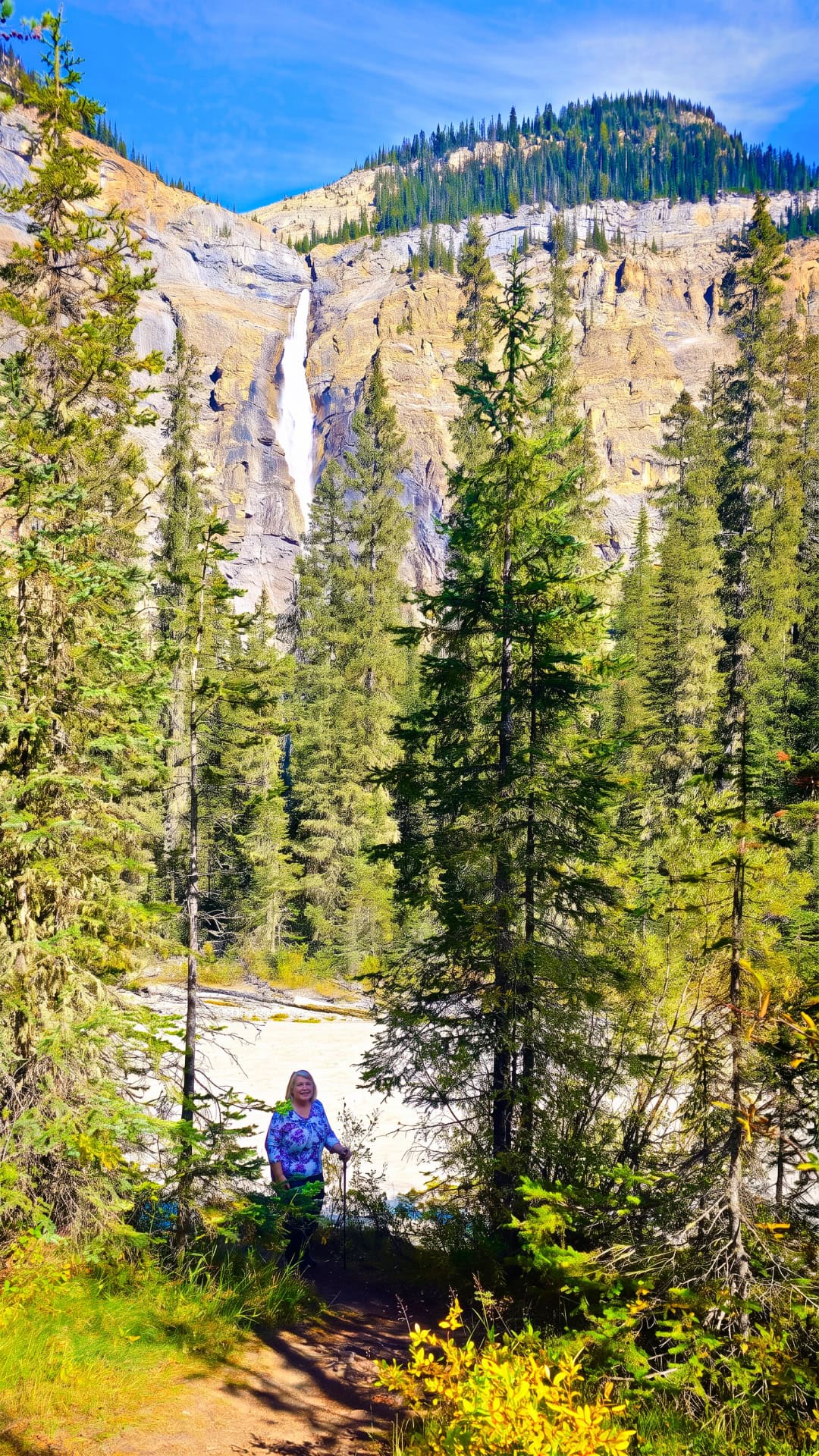
While in Golden, we rode our e-bikes around town and visited some really scenic waterfalls nearby. The treks to Takakkaw Falls and Brisco Falls were really easy. We could drive to the respective trailheads in the car and then walk just a few hundred metres to the viewing points.
{Jackie: Mike wrote the paragraph above. We obviously have different definitions of “easy”. We hiked in past the salmon and the trail turned very narrow and muddy and slippery. My legs and arms were too short to use the trees and bushes to get around tight narrow corners next to the river so I gave up. I returned to keep the salmon company while Mike continued on for a little while. Easy – NOT.}
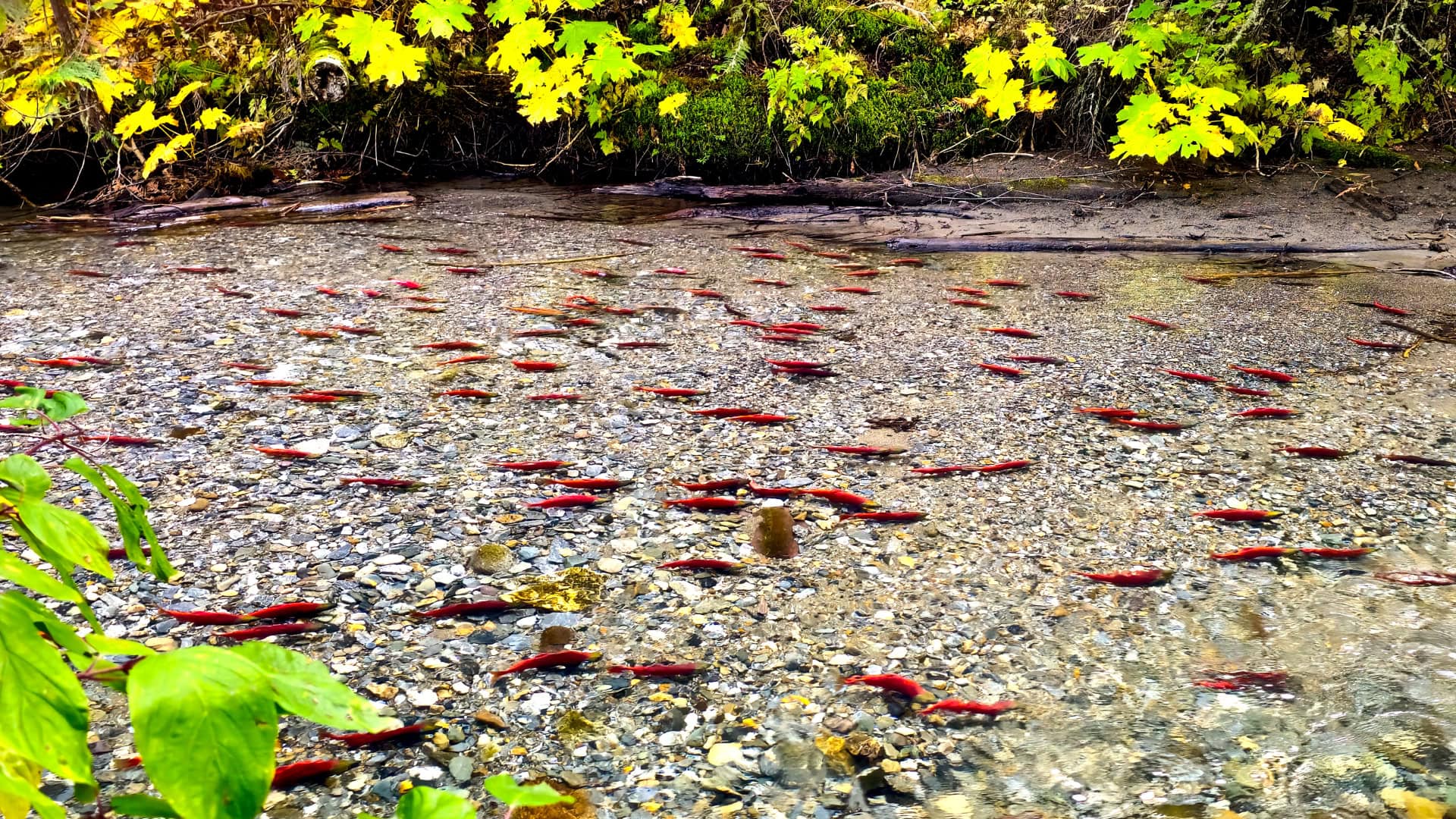
The few-hundred-metre hike to Brisco Falls took us upstream past thousands of Kokanee salmon that were swimming upstream to spawn. At this stage in their lifecycle, their bodies turn a brilliant crimson red, their heads turn dark green, and the males develop hooked snouts and humped backs.
Other hikers told us that bears visit frequently but only eat the tasty parts of the salmon and throw away the rest. Those same local hikers advised us to keep our bear spray handy. Since we don’t have bear spray. we didn’t stay long at Brisco Falls.
There is something about being told that bears are nearby, while standing beside a stream full of thousands of fresh salmon, that makes you suddenly appreciate the beauty of the scenery from a safe distance.
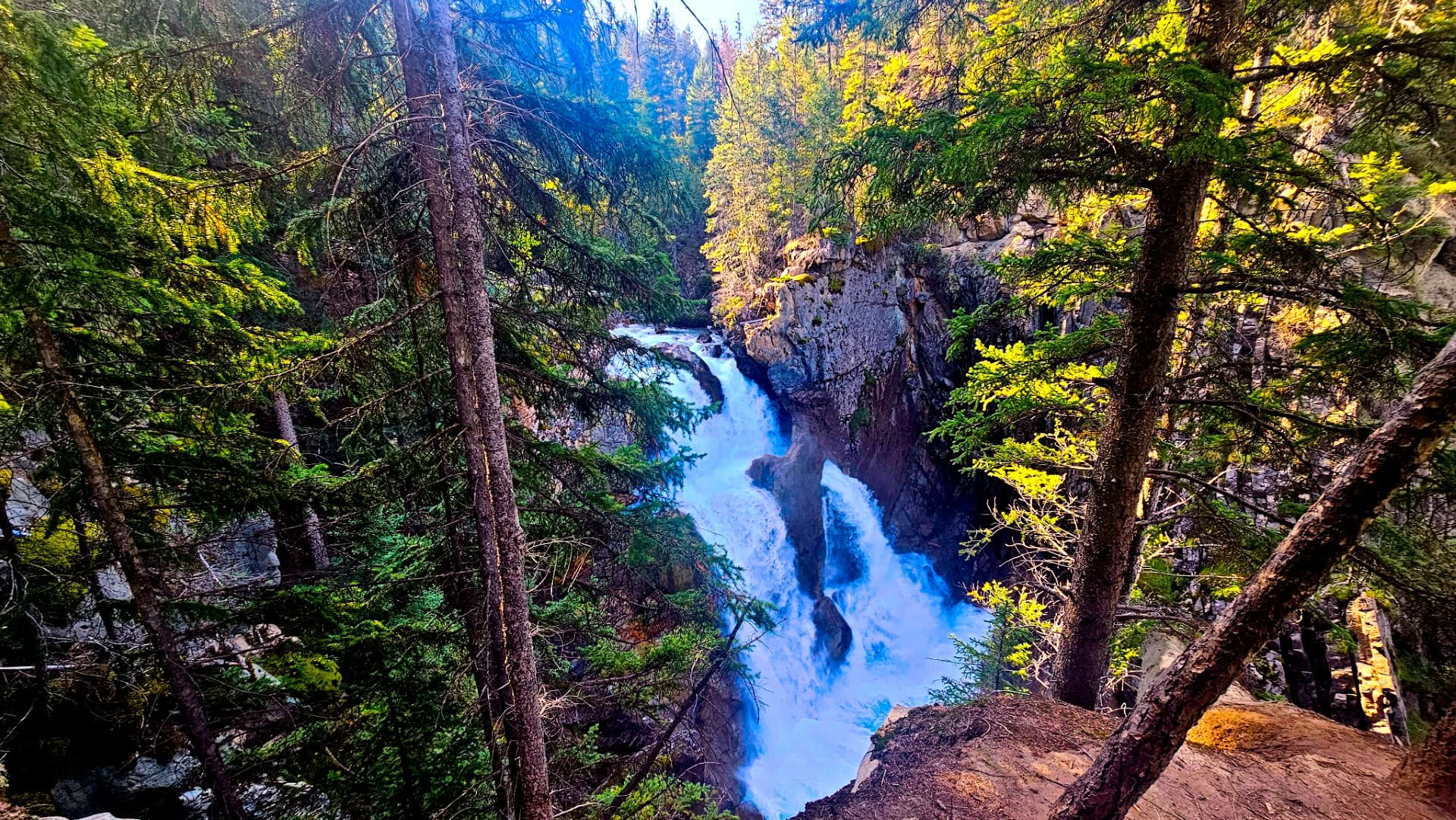
The hike to Lower Bugaboo Falls wasn’t very pleasant. The internet said the hike to the falls was about two kilometres on mostly level ground. Since the trail was well travelled and was depicted on our biking map, it was easy to follow. So that wasn’t the problem. In fact, there were a few flat sections, but the trail led us up and down seemingly endless steep, slippery slopes. Long before we got back to the car, we wondered how two people in their 70s could possibly have gotten it into their heads that a walk to Bugaboo Falls was a good idea. At some point, the question changed from “How much farther?” to “Whose idea was this?”
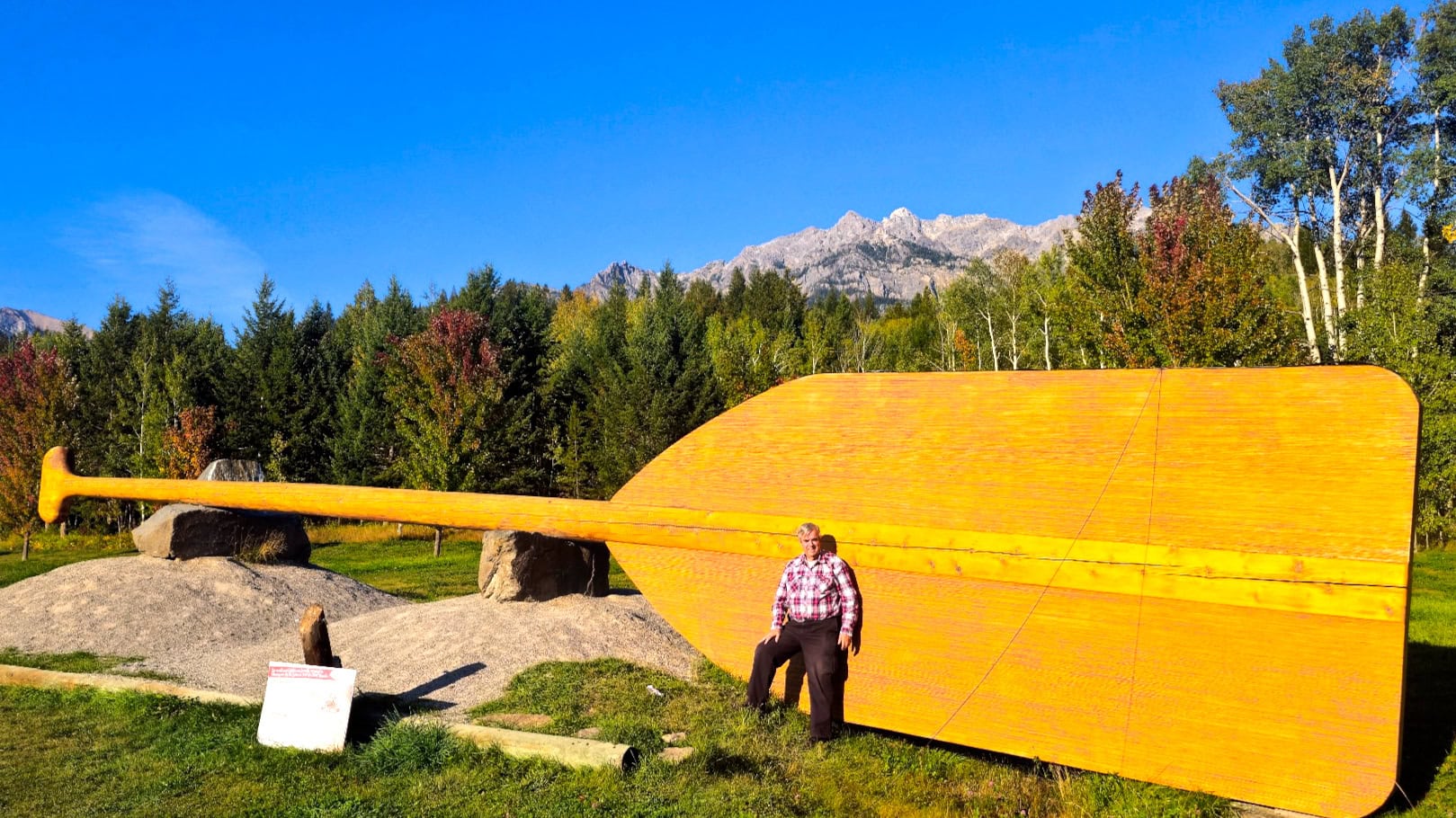
As it turns out, we weren’t the only fools in British Columbia. I can’t imagine what the guy who made this paddle was thinking. Google says it’s the largest paddle in the world. But why would anyone want to have the biggest paddle in the world?
If you are thinking that the paddle was intended to attract tourists, you would be right. But there’s a problem with that plan. The guy who owns the biggest paddle in the world doesn’t appear to have anything to sell those tourists. Not a cup of coffee. Not an ice cream cone. Nada. It’s just a really big paddle, sitting about 100 metres off the side of the road, where people stop to take selfies and then drive on.
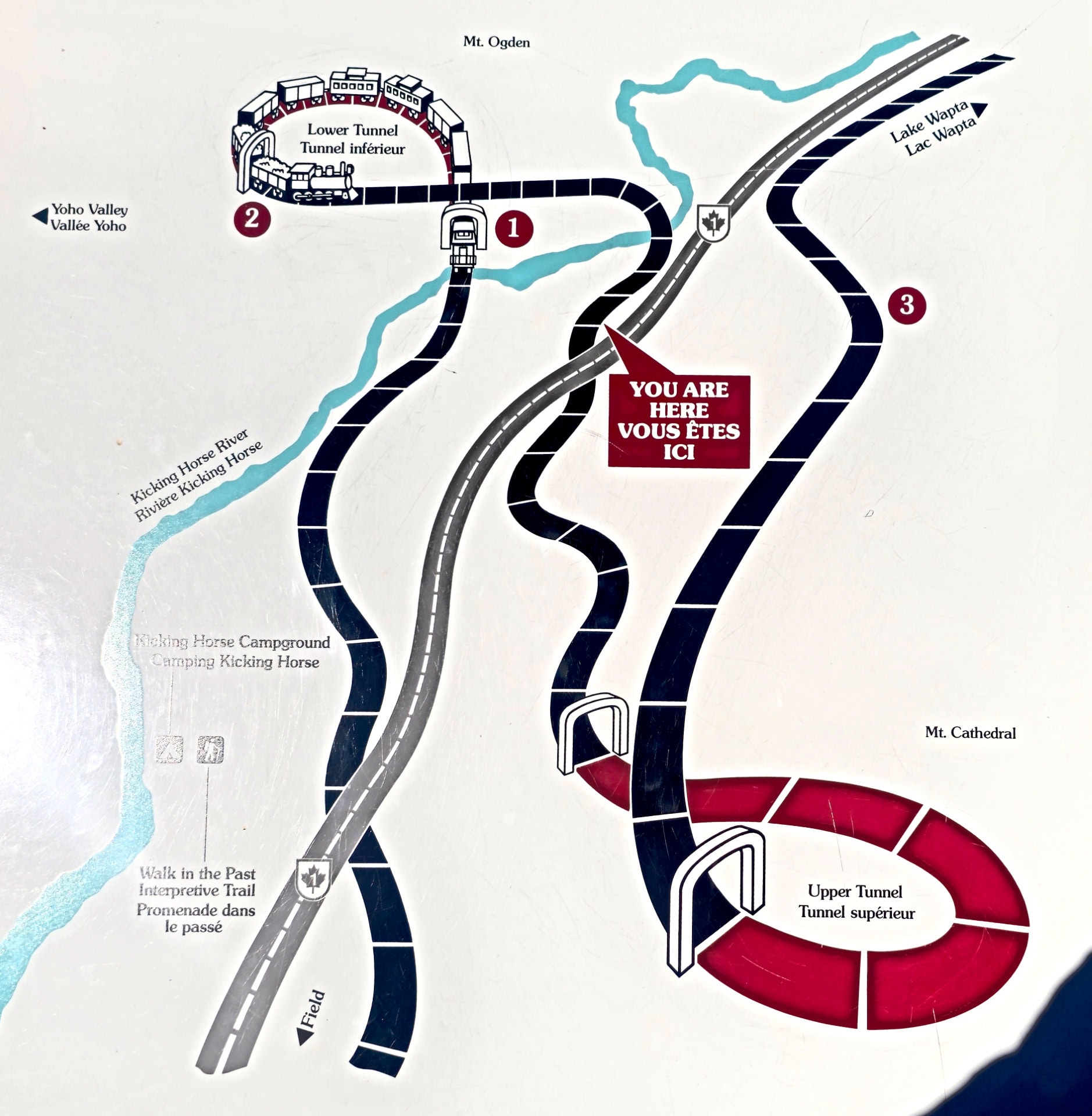
There are two unusual railway tunnels in Kicking Horse Pass. Together the two tunnels form a figure 8 with the Kicking Horse river flowing through the centre. They serve one important purpose; reducing the grade for the trains that pass through Kicking Horse Pass. Before the tunnels were built in the early part of the 20th century, there were railway accidents in Kicking Horse Pass because of the steep grade. Each of the two tunnels allows trains to change elevation, about 50 feet of elevation, while travelling a much longer distance than they would on the original route. The longer distance is achieved by the trains completely changing direction with each loop. It’s a good example of how the railway engineers figured out how to make the mountains cooperate, even if they had to make the trains go around in circles to do it.
And now we head to Revelstoke. What a gorgeous area this part of the country is. We could easily spend more time here than we are doing.
Leave a Reply