The Prairies (Flat Land)
The land really is flat. Many fields of grain stretch to the horizon and they are big. It’s harvest season, and I have seen fields with 3 combines harvesting the same field, and the combines were nowhere near each other. Generally, you see a cloud of dust in the distance long before you see the combine. And then, when you get closer, you see that the combine itself is huge. The prairies do have hills and valleys but somehow even the hills and valleys seem flat. It’s hard to explain how vast things are.
Travelling west of Brandon, we decided to stay a few days at a campground in Grenfell. Grenfell’s campground is small but has a couple of 50-amp fully serviced sites. With 50 amps of electricity, we can run our air conditioners without having to run our generator. With unlimited access to water and sewer, we could easily run the washing machine.
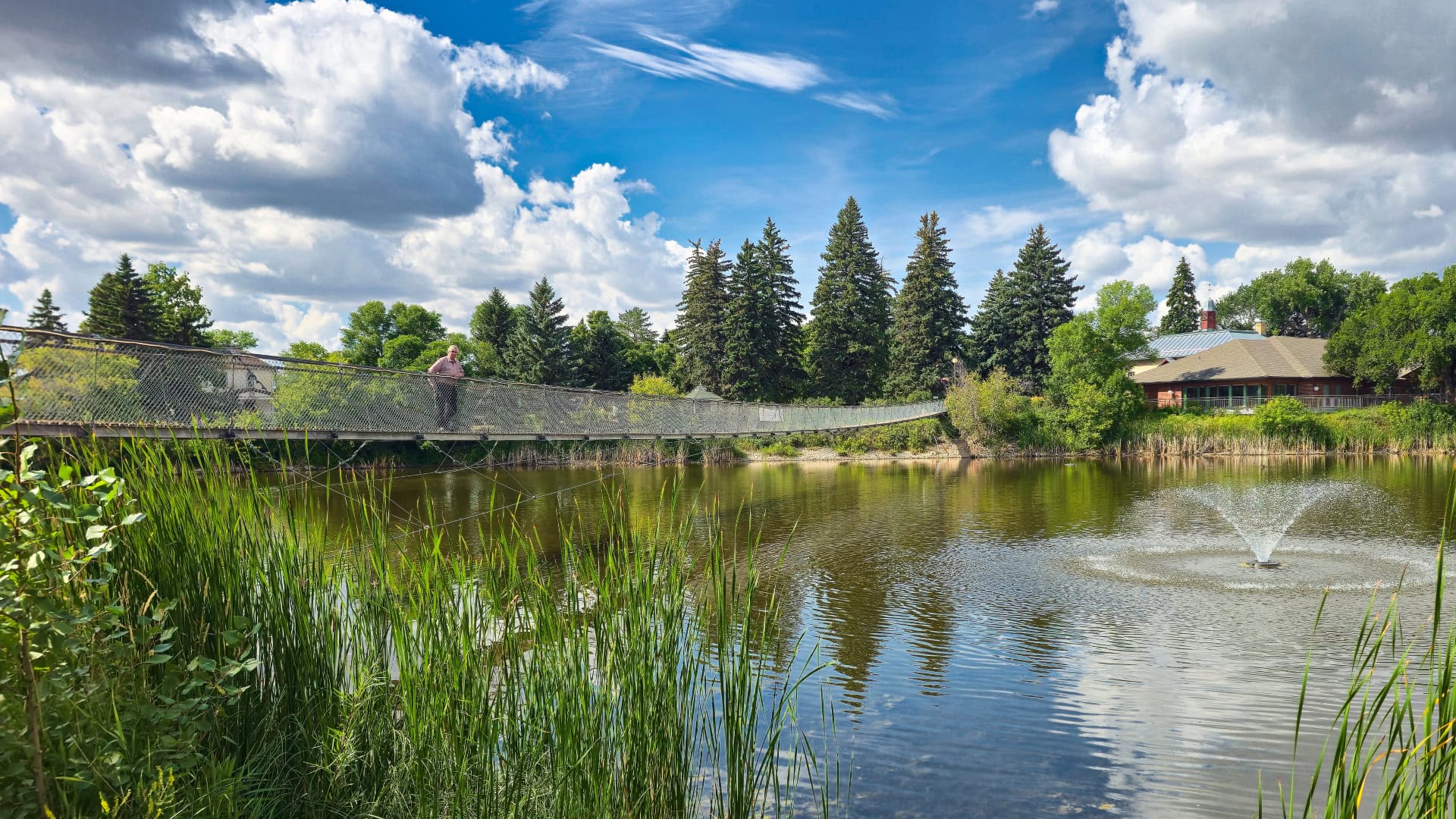
While the washing machine was running, we visited Wolseley, just a few kilometres further west. Wolseley has a swing pedestrian bridge. I am not sure why this bridge exists. It spans a small lake which I’m inclined to think of as a large, shallow pond. We parked at one end of the bridge, walked across it to admire a well-tended park, and returned to the car without recrossing the pond. Signs posted near the bridge indicate that it was originally built in 1905, destroyed by a storm in 1954, rebuilt in 1964, destroyed again in 1991, and rebuilt again in 2004. Perhaps its real purpose is to serve as a tourist attraction. If that’s the case, it worked on us. We had a nice meal in a restaurant in Wolseley, and we probably would not have stopped there if it hadn’t been for a swinging bridge over a shallow pond.
As I am writing this, I am thinking about our travels earlier this year in the southern USA states. When passing through small towns and cities there, we often saw abandoned homes. In some towns, it seemed like as many as one in ten homes were boarded up. That’s not the case in small towns in Canada. People who live in small Canadian towns might not be thriving right now, but they seem to be coping. As you drive and walk through Canadian towns, you see homes that might not have prosperous owners, but you don’t see many that have been obviously abandoned like those we saw in the southern USA.
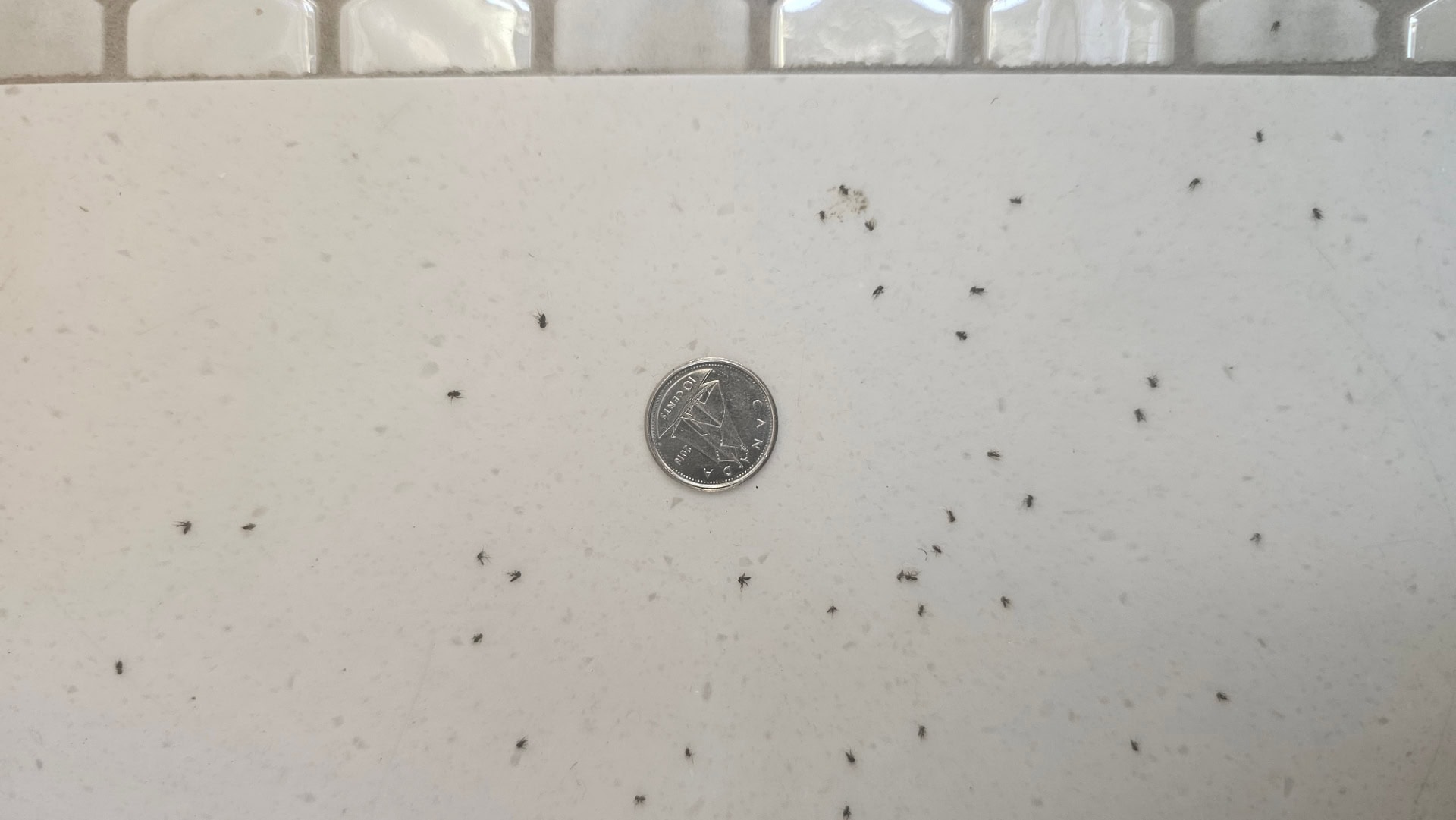
Every evening recently, I hang an electrocution device near the front door of our motorhome. At intervals ranging from several times a minute to once an hour, the device emits a satisfying cracking sound. This signals the death of one more biting midge, more commonly known as a no-see-um. In the morning, I sweep the debris out the door. It’s not exactly the kind of housekeeping activity they advertise in RV brochures.
In more scientific terms, no-see-ums are called Culicoides. The females bite but seem to prefer our ankles. Your ankles itch for a while, but there is no noticeable welt like with a mosquito bite.
As you can see if you zoom in on the photo, Culicoides are about the size of a grain of sand, roughly 2–3 mm long when compared with the 18-mm Canadian dime. They are clearly true flies (Diptera), with a compact body, a single pair of wings, and longish legs. I find it remarkable that a creature as small as this can actually fly with intent and purpose. The thing actually has a brain, and all the parts necessary to function as a living, and, I might add, extremely annoying organism.
The University of Saskatchewan describes Culicoides as flies under about 4 mm long, with a somewhat hump-backed thorax, long antennae and hairy wings. They specifically state that they are small enough to penetrate normal mosquito screens. We leaned that the hard way as it explains how they are getting into our motorhome. Unfortunately, it also explains why the electrocution device is getting such a workout.
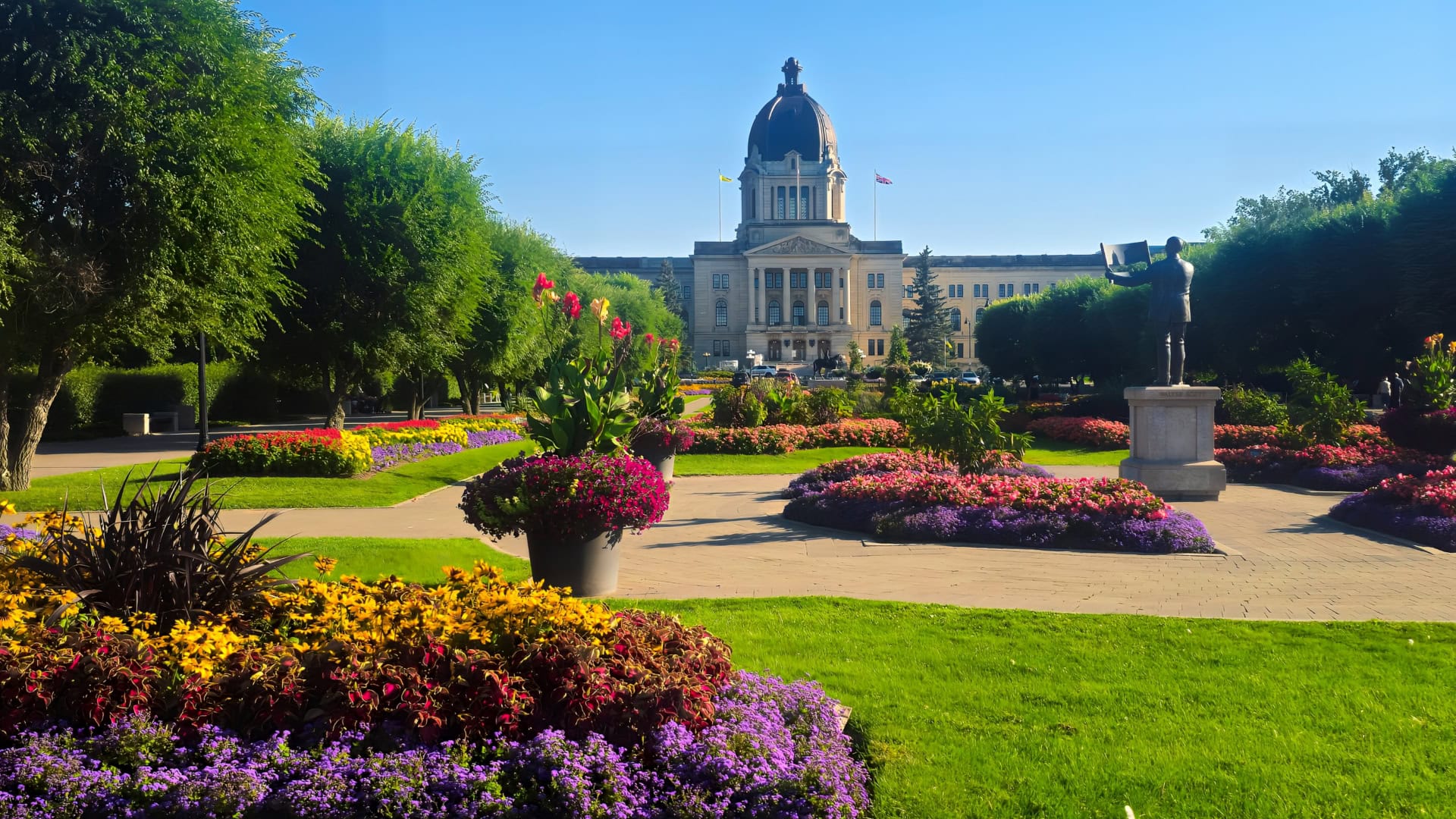
Further west, we came to Regina. Did you know that Regina was once the capital of the Northwest Territories? We learned that on a self-guided audio tour of Regina’s historic city centre. Regina lost its status as the capital of the Northwest Territories but became the capital of Saskatchewan when Saskatchewan became a province in 1905.
With that knowledge, I figured that I should be able to add the sticker for having camped in the Northwest Territories to the side of our motorhome. Unfortunately, I wasn’t able to convince Jackie. So that destination remains unclaimed.
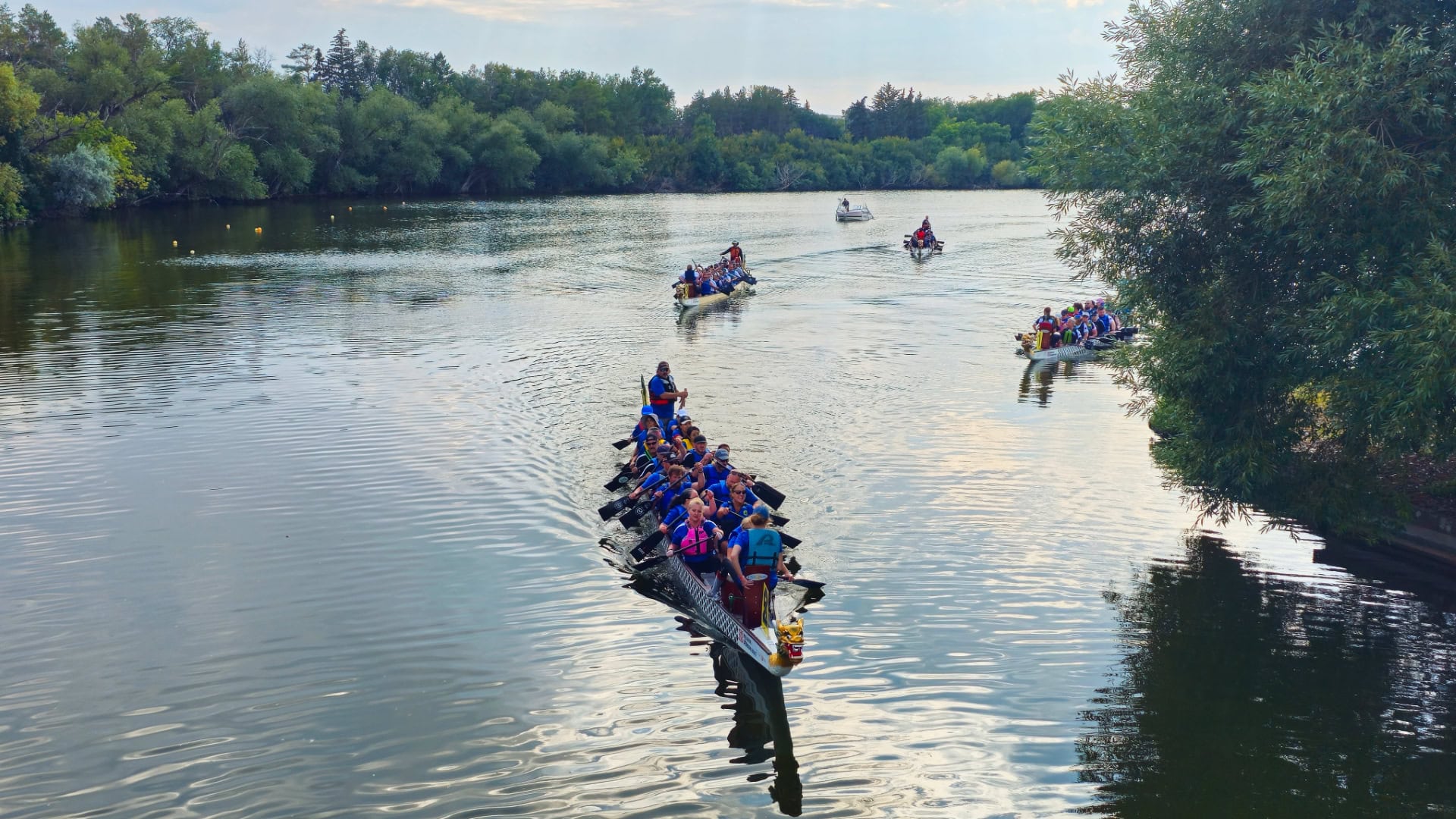
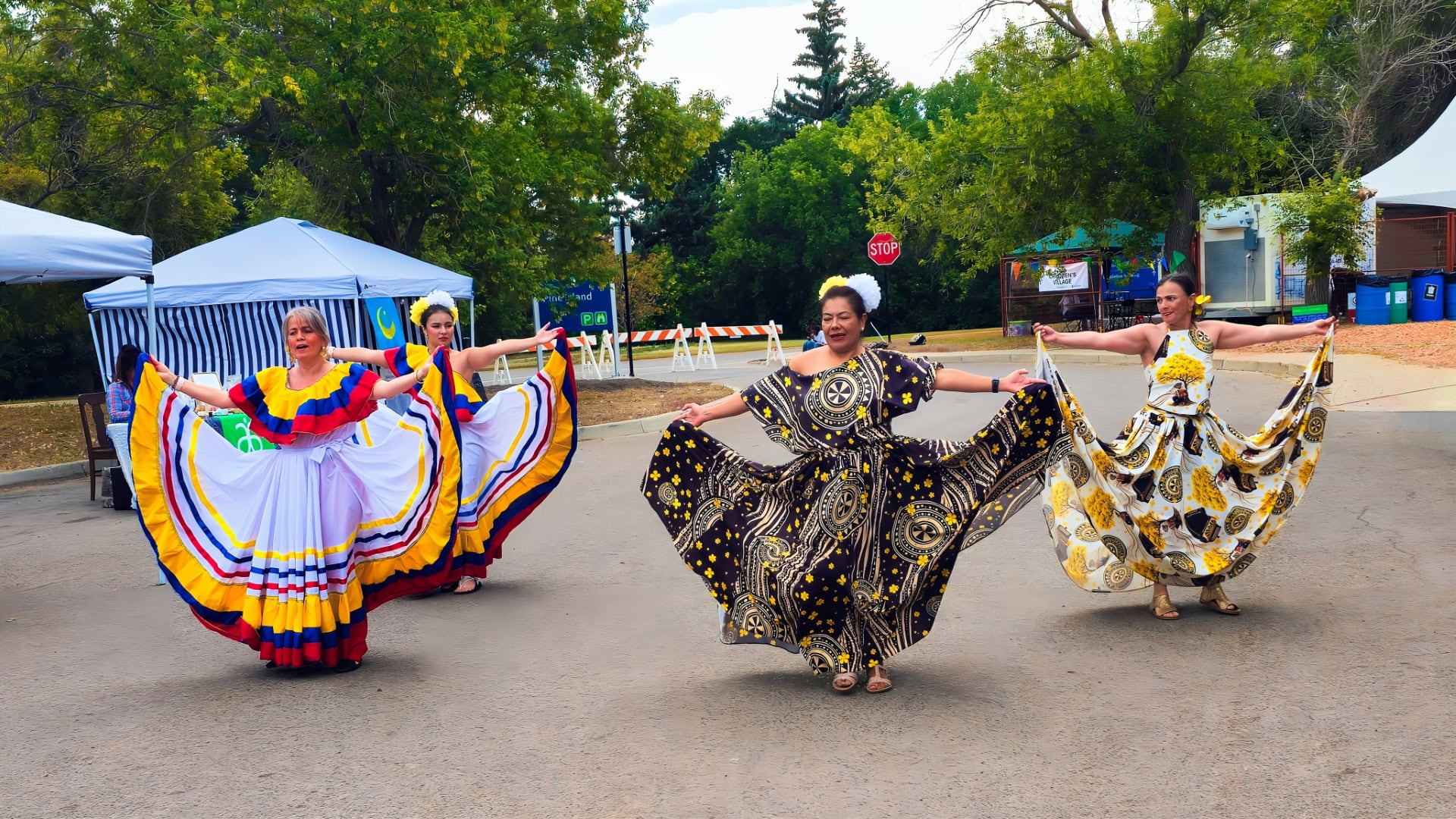
At least 16 dragon boat teams competed in the Regina Dragon Boat Festival on Lake Wascana on the weekend of August 22/23. We only attended for a few hours, until the officials interrupted the races because of a passing thunderstorm with lightning.
Between races, we were entertained by Mexican dancers.
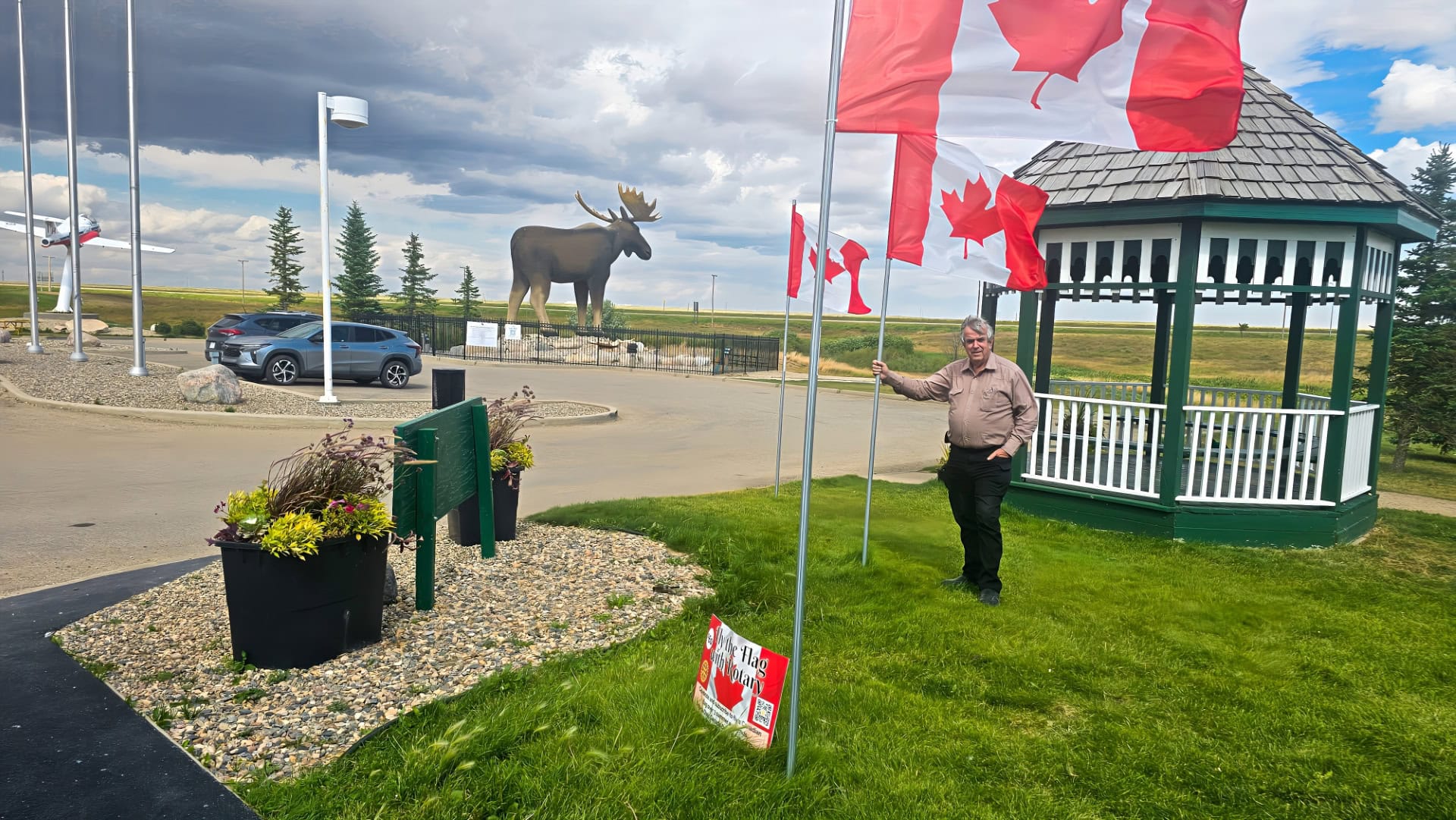
I’ve always liked the name of the city of Moose Jaw. The city uses Max the Moose, the tallest moose in the world, as its symbol. After Max was christened, Norway built a similar moose replica that was a little taller. So Moose Jaw made new antlers to reclaim the title. Moose do shed their antlers annually and grow bigger antlers the following year. So it’s a legitimate reclamation of the title.
The name Moose Jaw comes from the Indigenous Cree name for the area, which the tour guide said is derived from Cree words meaning “a warm place by the river.” Depending on which device I use and which AI tool I ask, I get different answers, but they all seem to agree that the name was derived from an Indigenous Cree name. At this point, I have decided that the important thing is not to get into an argument with either a Cree scholar or an AI chatbot.
Moose Jaw is very tourist-friendly. It has an impressive tourist information office right next to Max the Moose.
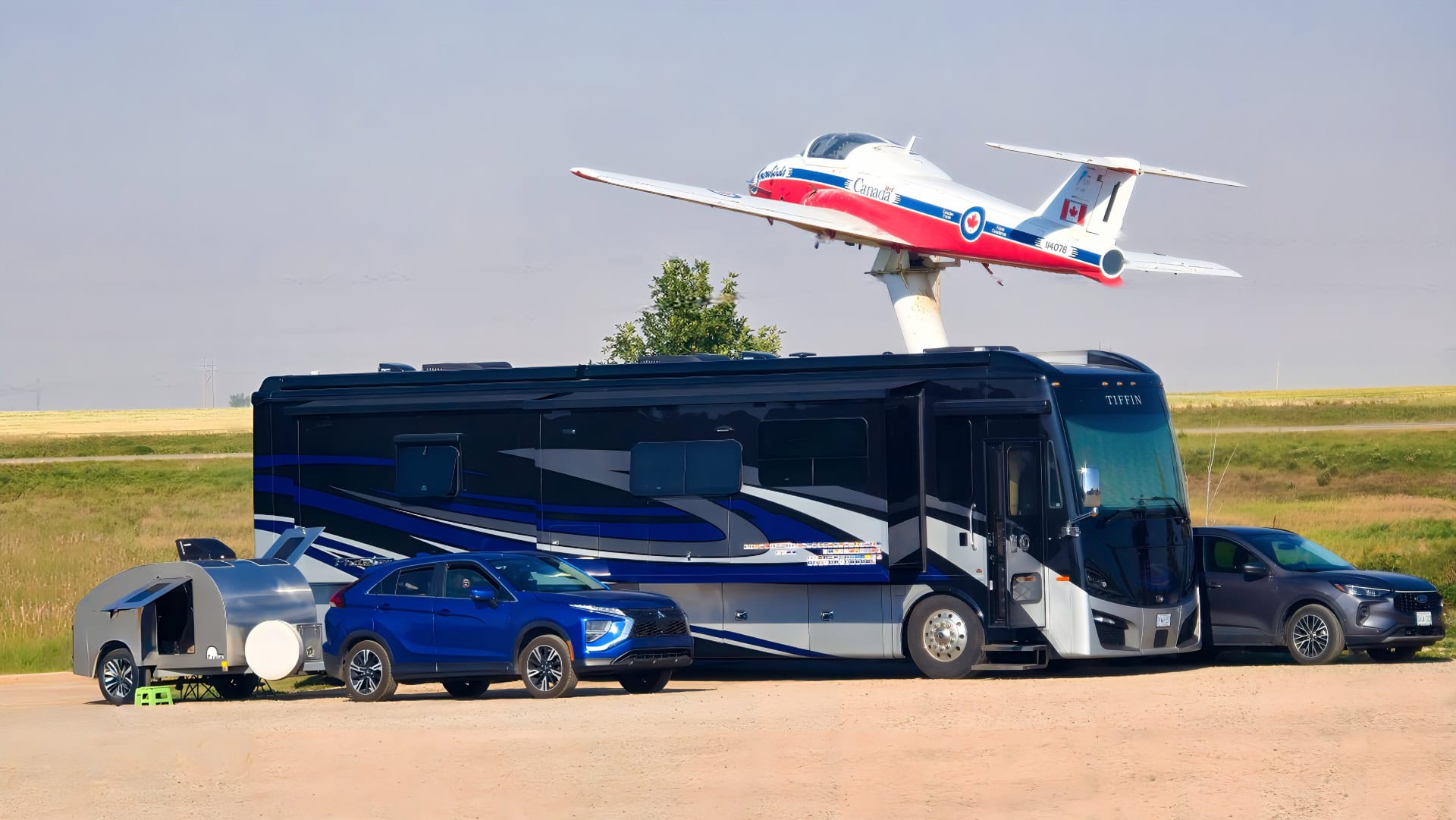
Since Moose Jaw is the home of the 431 Air Demonstration Squadron, more commonly called the Snowbirds, there is a pylon with a Canadair CT-114 Tutor jet at the information office as well. We camped for three days in its shadow. Jackie calls the picture above the big and the small of it. Notice the camper parked next to our motorhome.
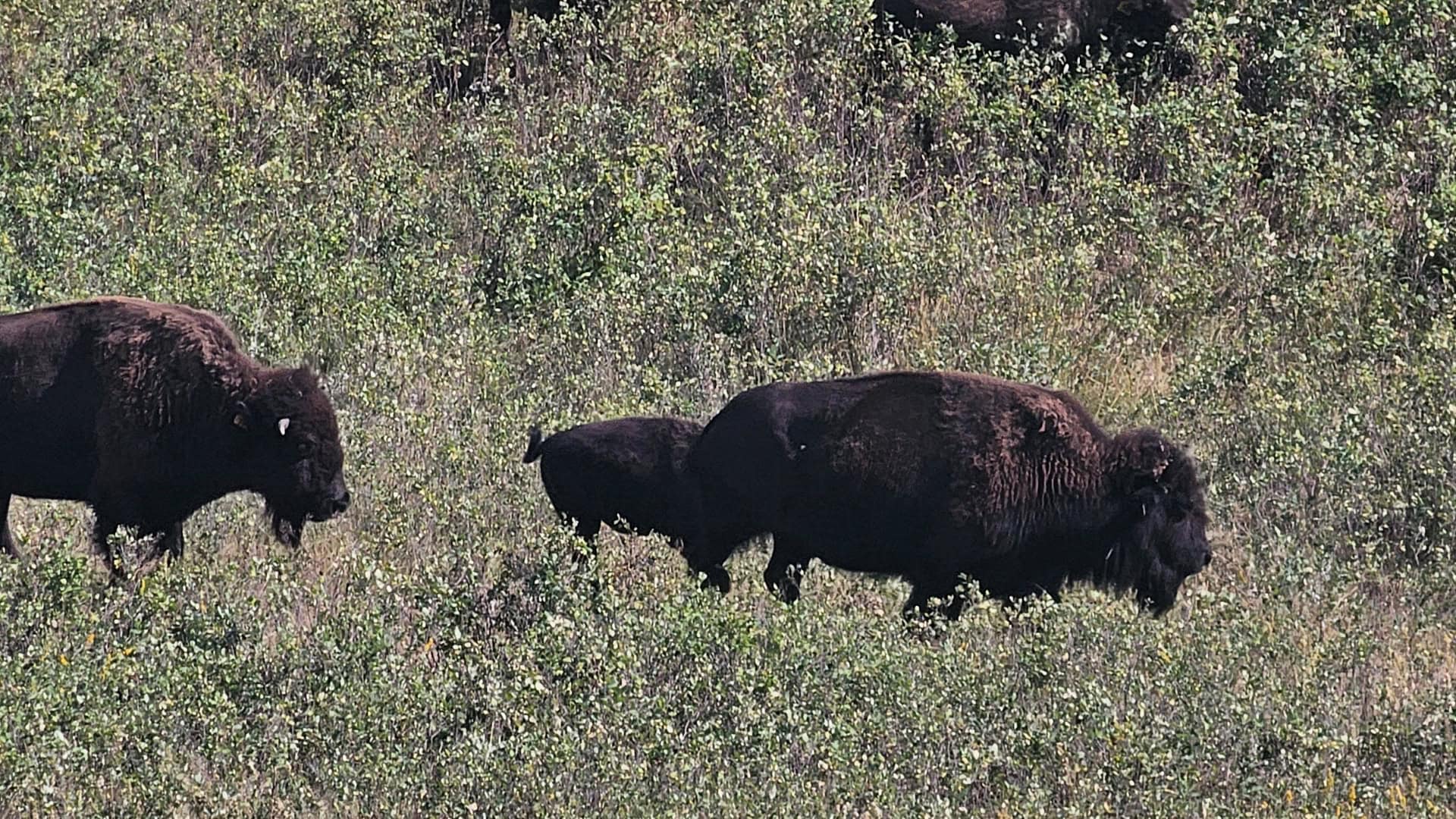
We hadn’t seen any bison roaming the plains as we travelled west, but we were told that we could find a herd of bison in Buffalo Pound Provincial Park. So we spent an afternoon in the park hunting bison, with a camera, of course.
I asked ChatGPT to explain the difference between buffalo and bison. ChatGPT explained that buffalo and bison are quite different animals. It was bison that used to roam the plains of North America. European settlers began calling bison “buffalo,” and the name stuck. So, after all this travelling across the Prairies, we finally found the animals we had been looking for even if they turned out to be bison and not buffalo.
Leave a Reply