The Oregon Coast Road
If you read the previous blog, you’ll know that we had some trouble with our towed car. A roll pin inside the transmission/transaxle had shifted, allowing a larger pin to move out of position and start battering other components inside the transmission. Not exactly what you want happening inside an expensive piece of machinery!
The Ford dealer in Warrenton, Oregon, undertook to replace the transmission under warranty. Unfortunately, our travel plans were put on hold while we waited for a new transmission to arrive.
The transmission finally showed up a week later, but things didn’t go quite as smoothly as hoped. While reinstalling the Secondary On-Board Diagnostic Control Module C (SOBDMC), the mechanic broke off a lug while using a torque wrench. We had to wait another week for a replacement module. While working on the car, and waiting for parts, the mechanic must have left a light on in the car because the 12 volt battery wouldn’t accept a charge once he did get the car back together. As a result he also had to replace that battery. So, fixing one thing can sometimes create an entirely new problems!
To be fair, Ford did provide us with a car to use while ours was being repaired, and all the costs were covered under the drivetrain warranty. The problem first appeared on October 17, and our car was finally running like new again on November 4. That’s almost three weeks of unexpected vacation, although not quite the kind we had in mind!
During that period, we didn’t travel very far. We did move the motorhome twice to different campsites south near Tillamook Oregon from our original location near Seaside. All three campsite locations were within an hour’s drive of our disabled car.
Tillamook is famous throughout the USA for producing 189,000 pounds of cheddar cheese daily, yes daily. We did take the self guided tour of the Tillamook cheese factory while we were there. It’s quite the busy place, with conveyor belts everywhere and people in smocks watching the cheese whisk by on those conveyors.
The weather didn’t do much to improve our spirits. When it wasn’t actually raining, it was threatening to rain. According to our audio guide, rain is pretty much par for the course along the Oregon coast at this time of year. In fact, the region can receive more annual rainfall than the Amazon rainforest. I’m not sure who came up with the idea of comparing Oregon to the Amazon, but judging by the weather we experienced, I wasn’t about to argue!
We have yet to take our e-bikes for a ride.
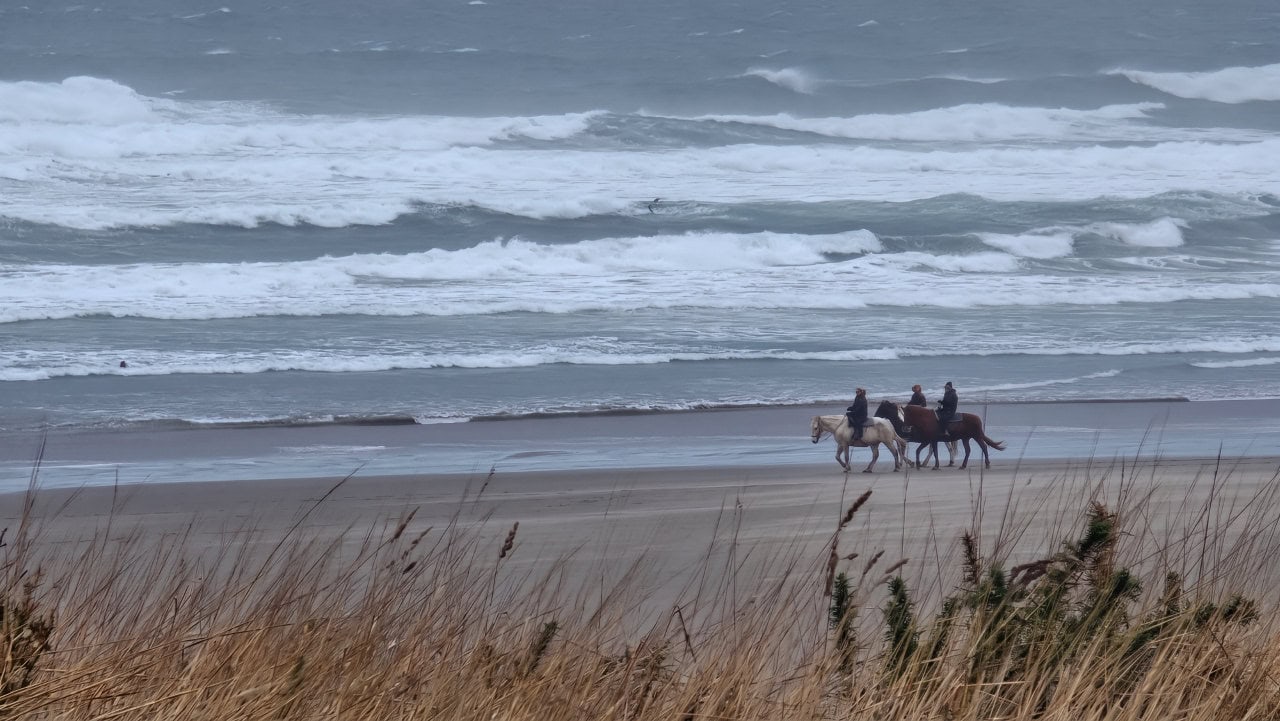
Actually, it wasn’t just the wet weather that kept us off our bikes. There is really only one main road running along the Oregon coast: Highway 101. Unfortunately, it isn’t exactly a cyclist’s paradise. There are bike lanes within some of the villages and towns, but the highway connecting these towns is another story. The road winds through the hills, with plenty of blind curves and very little room for cyclists. After taking a good look at the road, we decided that riding our bikes along Highway 101 would be somewhere between foolhardy and borderline suicidal. We decided that staying alive was probably the better option.
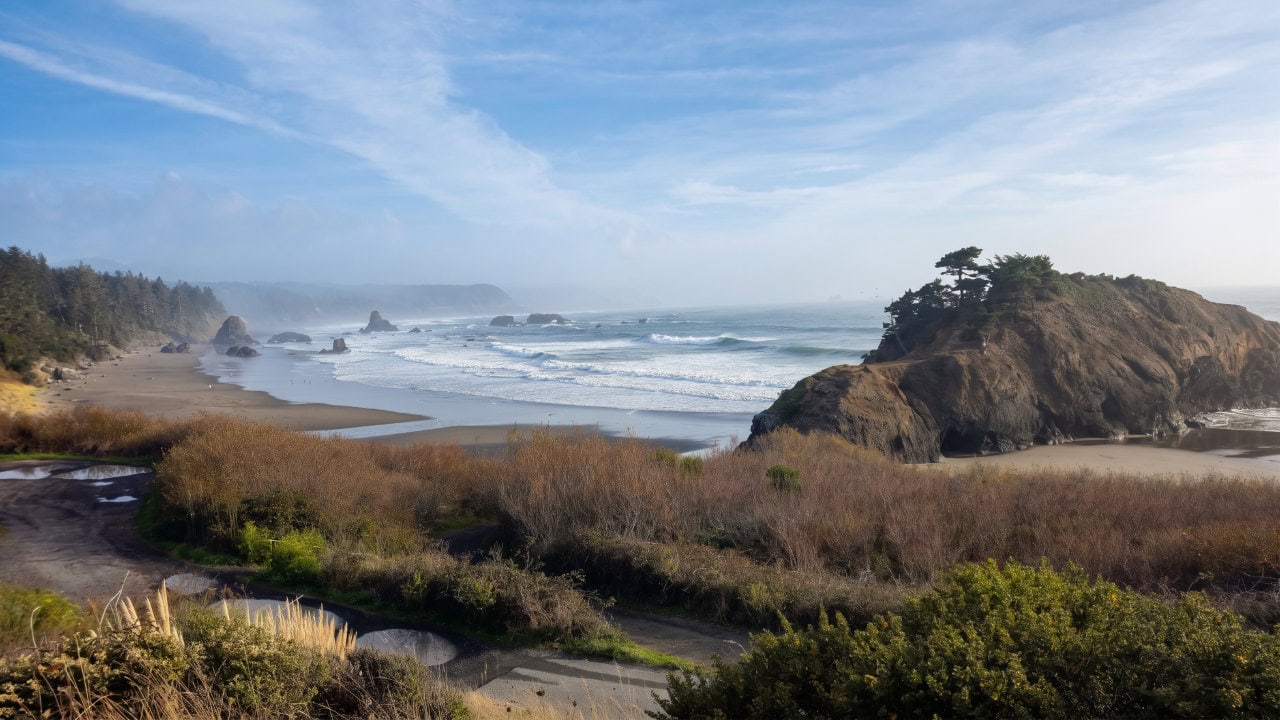
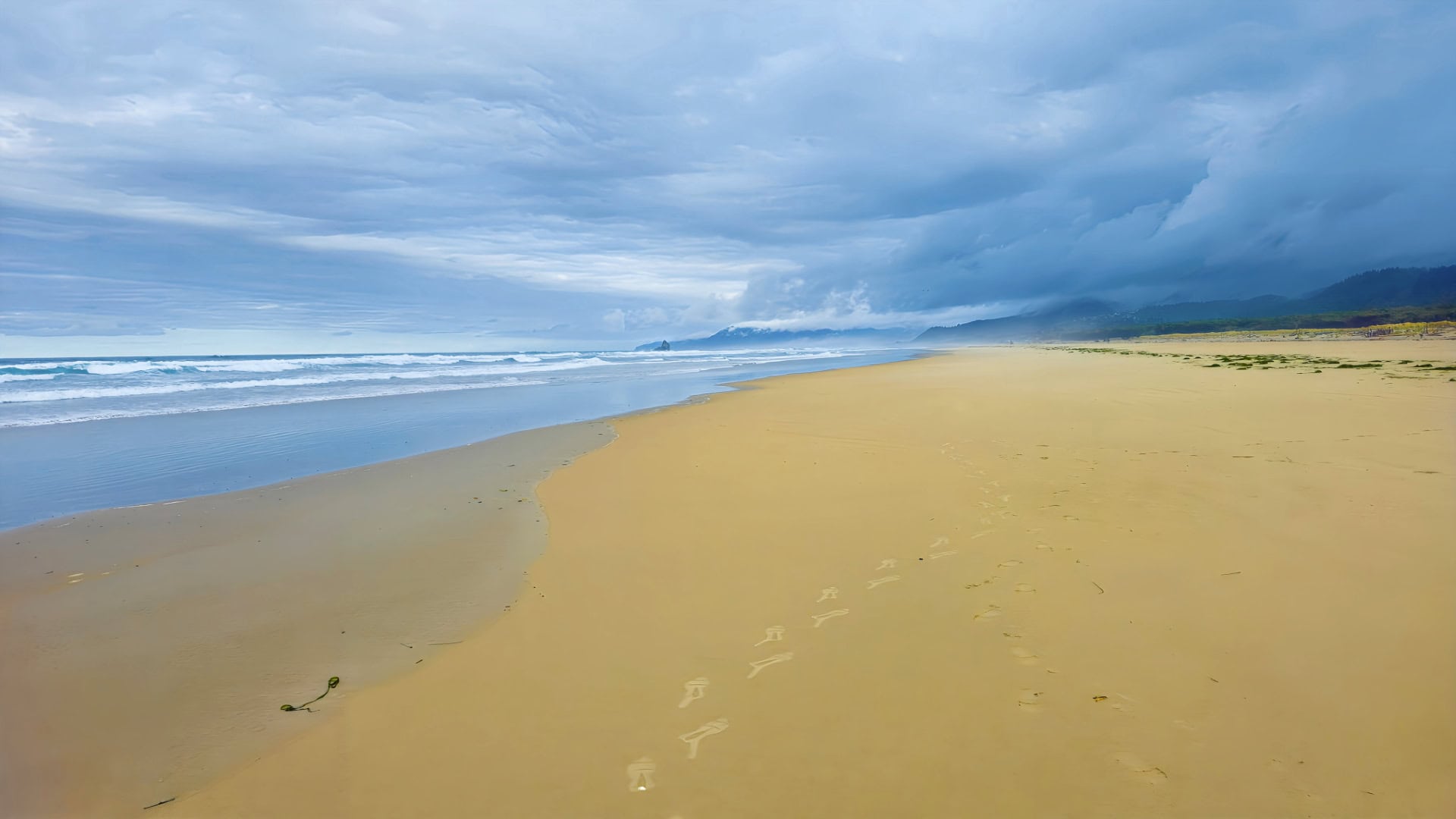
The photo at the beginning of this blog and the one above shows a couple of the many beautiful beaches along the Oregon coast. We often saw huge rocks just off shore, These rocks are called “sea stacks”. They were formed by volcanic action millions of years ago. They are essentially basalt, a very hard volcanic rock which has been worn round by the pounding of the sea. Oregon’s beaches are mostly deserted. Occasionally, we did see someone walking a dog or perhaps one or two people standing in the surf casting a fishing line. We never actually saw anyone catch a fish. Perhaps they were just enjoying the scenery, or perhaps the fish had all read the fishing regulations and decided to stay away!
Over the course of the past year we’ve really enjoyed camping at city and county campgrounds. The prices at these are generally quite a bit lower than privately run commercial campgrounds. The only drawback that could impact on our enjoyment is that the campsites at city and county campgrounds generally don’t have black and grey water dump connections at each site. However, since we rarely stay more than a week, it’s really not much of a problem for us to empty our tanks while checking out at the dump site near the exit.
While on the Oregon coast we stayed at two county campgrounds. The first was Boice-Cope Park, a Curry County campground. It was perched on a cliff overlooking the Pacific. We had a tremendous view. Other than the campground host, there was only one other camper, a fellow in a tent. I wouldn’t have thought that he enjoyed his stay in the campground because it rained almost continuously for 3 days straight. However, the rain didn’t stop him from singing at the top of his lungs. He was a Janis Joplin fan.
Perhaps one of the most attractive campgrounds we stayed at this year was the Harbor Vista County Campground & Park in Florence Oregon. Each campsite was separated from its neighbours by trees and foliage. These were so thick and dense that you couldn’t see through to the neighbour’s campsite, not that we had any neighbours. The campground had 45 sites but I think that there were only about 5 other campers during the 3 days we stayed there. Each site was paved and included a picnic table and fire ring. The campground was perched on a rocky cliff overlooking the Siuslaw River just at the point were the river flows into the Pacific Ocean. So a short walk across a neatly trimmed lawn to a viewing platform afforded spectacular views of the seascape.
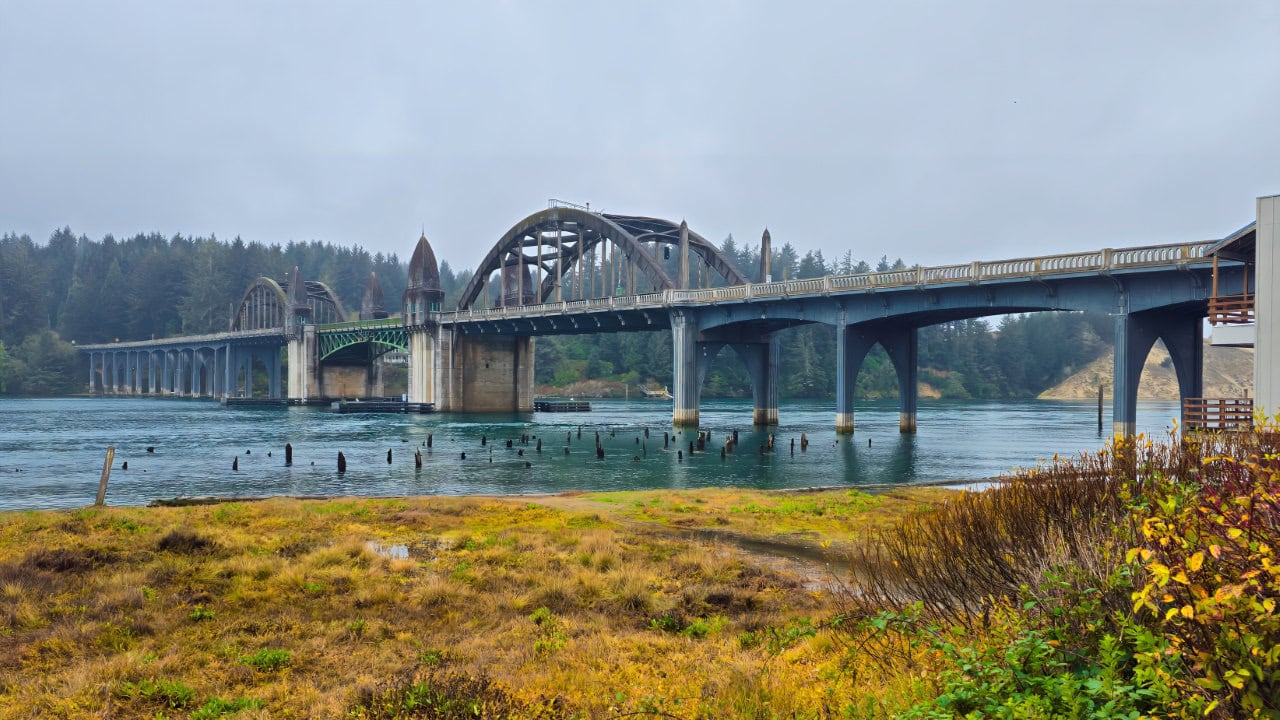
The bridge in the photo above was designed by Oregon bridge engineer Conde B. McCullough and his team. We took the photo while walking through the historic town centre which was itself very picturesque.
McCullough was responsible for designing an impressive number of bridges in Oregon. Depending on which source you consult, his team designed and supervised the construction of somewhere between 160 and 600 bridges over a period of several years. His work was closely associated with Oregon’s ambitious bridge-building program, which began in the 1930s during the Great Depression under President Franklin D. Roosevelt’s New Deal.
The New Deal provided funding for major public infrastructure projects, creating much-needed employment during the Depression while improving transportation throughout the country. Oregon’s bridge-building program was a particularly impressive example of that investment.
The bridge in the photograph is an interesting example of the engineering techniques used at the time. The south end of the bridge (the far side in the photo) rests on bedrock, while the other piers are supported by Douglas Fir timber piles driven 30 to 40 feet into the riverbed.
As we travelled farther along Highway 101, we began to recognize McCullough’s bridges by their distinctive architectural features. Many have elegant Gothic-style arches topping the pylons at their entrances and exits. They are quite beautiful structures, especially considering that their primary purpose was to get people and vehicles safely from one side of a river to the other.
It’s not often that you find yourself admiring a bridge as much as the scenery around it, but McCullough’s work certainly deserves the attention.
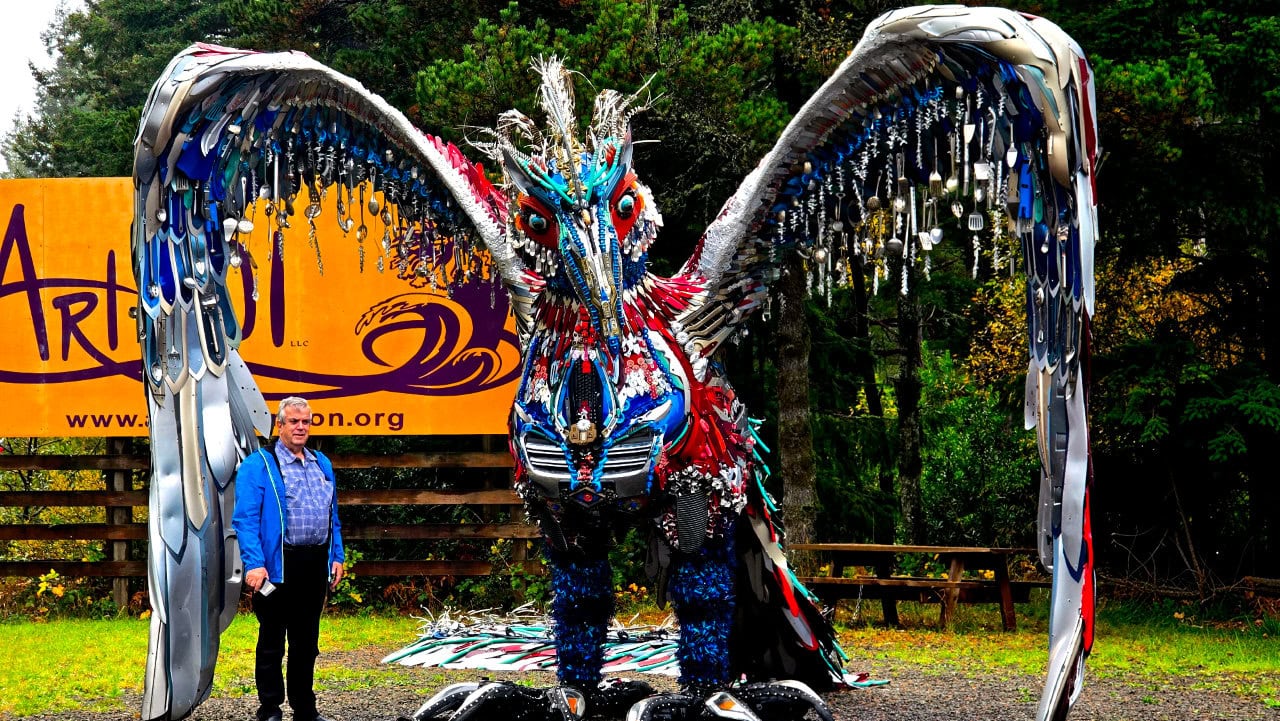
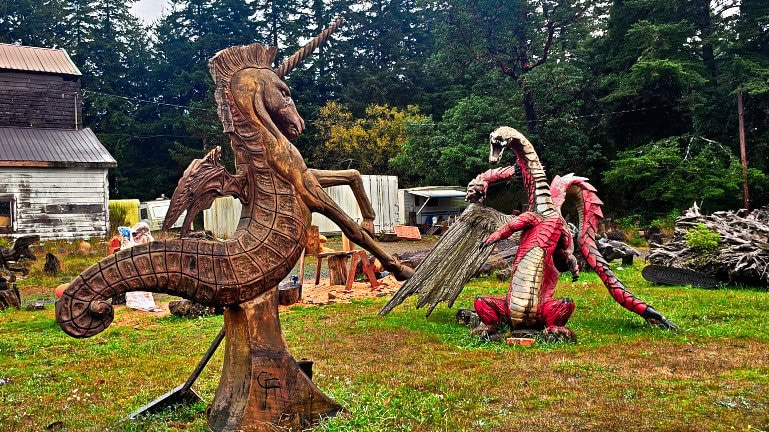
We also encountered some rather unusual works of art along Highway 101 before eventually leaving Oregon and crossing into California.
Some were quite impressive, and others were certainly different. It seems that along this stretch of the coast, just about anything can become attractive if someone has enough imagination, a few tools, and access to a suitable rubbish that can be converted into works of art!
The one thing that really surprised us as we travelled the Oregon coast was that although the midterm elections were underway there were no posters to be seen on any lawn or road proclaiming either a Democrat or Republican candidate. We found this was particularly surprising, given that the news on American TV was so polarized. We found no signage to indicate that an election was even underway. Talking to friends in Colorado and California, it appears that they also had very few signs. The few they did have were removed quickly, the morning after the election. By contrast, while we were travelling through Alberta earlier, there were many lawn posters proclaiming either favour or disfavor for Alberta’s separation from Canada. As travellers, if you hadn’t been keeping up on the news, the mid term Americian elections appeared to be a non-issue. Not at all what we expected.
And so, after an unexpectedly long stay in Oregon, we were finally back on the road and heading south into California.
Leave a Reply